Our results indicate that many conclusions of previous environmental surveys do not always apply to Georgia. This is perhaps due to Georgia’s strong position in the forest products industry, or its changing demographic scheme. A surprisingly positive result, which contradicts the results of many other surveys, is that a majority of respondents do not express great concern regarding the treatment of forests in Georgia. Almost every survey and article dealing with the environment or natural resource issues reports a consistent, strong theme of environmental concern.
A possible explanation for this finding may rest with the wording of our survey question; it simply asks if respondents have ‘any concerns about the way forests in Georgia are being treated’. Thus, the definition of the term ‘concern’ may be misconstrued. It can refer to a vested interest in forest issues, or apprehension about the management of the forests. Therefore, the response to the concern question may depend on the respondent’s interpretation to the question. For our purposes, the apprehension definition was assumed to be the one chosen most often by the respondents, and it formed the basis for our analysis.
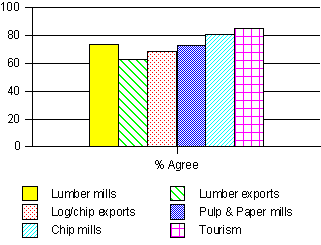
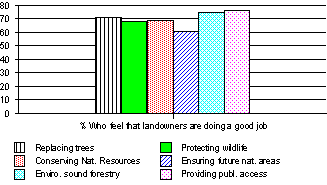
It is likely that as a forest products leader and the largest timber producing state in the Southeast, the public associates the forest industry’s success with sound management practices. Support for this can be found in figure 5, where the majority of people feel forest landowners are doing a good job in several different areas of forest management, from replacing trees after harvest to protecting wildlife. The majority of the sample also supports the future development of a wide variety of forest industries, from the construction of lumber mills to the construction of chip mills. The fact that almost two-thirds of the state is forested could be another explanation for the lower than expected level of concern. The relatively large amount of forest cover, combined with a variety of public outreach programs may also contribute to a more positive image.
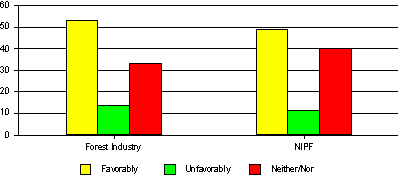
While a considerable majority of the sample is supportive of the forest products industries, approximately one-third of the respondents said that they did not have either a favorable or an unfavorable opinion of timber landowners and the forest products industry. These numbers may indicate that while a sizable majority are relatively satisfied with forest management in Georgia, many do not know who to attribute that success to – forest industry, private landowners, or government regulation. Another possible conclusion is that those who fall within the neutral category represent a group that could best benefit from future education efforts.
In contrast to high levels of support for current forest management practices and the rather pragmatic definition of trees as similar to an agricultural crop, there is also a high level of support for current and future government regulation of harvesting on private forest land. Over 47% of the sample feel there should be more regulations in Georgia. When questioned on what types of new regulations were needed, the responses focused on harvesting limits, regeneration guidelines, and enforcement issues. However, it is not clear as to how intense the public feels about the implementation of new regulations.
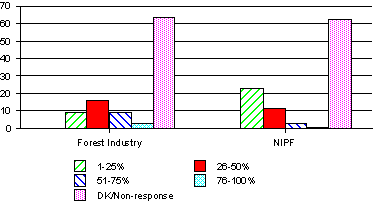
It may be worthwhile to clarify what regulations currently exist, how these are being adhered to, and by whom. There is substantial misconception regarding who owns the majority of forest land in Georgia. It may be possible that if the majority of people feel the land is being managed well, but do not realize that private non-industrial landowners are responsible for a good deal of that success, then that misconception may account for private landowner’s relatively low approval rating. The respondents’ perception of forest land ownership is the opposite of what it is in reality. Over 60% of the respondents could not give any answer to the question regarding percent of forest ownership and most of those who did respond had the ratio incorrect.
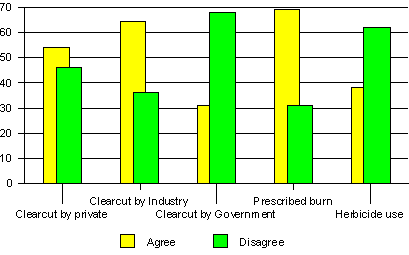
It is this apparent paradox that leads us to believe that the public is not confident in their understanding of forestry in Georgia. The uncertainty present in their responses regarding where to allow clearcutting when they are told the trees will grow back, the partitioning of forestland ownership, and their opinions of forest products companies and private timberland owners, all seem to suggest that there are a number areas where public education and information may be needed.
We hypothesized that rural residents and forest owners would regard forest management practices more favorably than urban residents and non-forest owners. In both cases our hypotheses have been shown to hold true. Forest owners and rural residents consistently exhibit more support of silvicultural practices and private property rights, and considerably less support for government regulation of forest practices. Presumably they are more aware of forest management practices because they are familiar with them through personal associations, forest industry location, employment opportunities, and a closer affinity with the land. This may also explain why they exhibit more concern about the forests. Their familiarity with the land allows them to see both the good and the bad forest practices. In addition, they are more likely to be affected by any new forest regulations.
Although Bliss et al. (1997) caution against the assumption that forest owners and non-forest owners are two distinct and different groups of people, we do see some indication of just such a result in our study. However, it should be noted that many of the deviations, though significant, do not represent major differences on all of the issues present in the survey. Often, the majority of both groups have the same response and it is the degree of support or non-support that differs significantly. This same relationship applies to all the significant differences we found.
Though the majority of respondents report a knowledge of clearcutting, the number of people who have never seen or heard of it seems fairly high (26%), and lends credence to our hypothesis that many Georgians possess incomplete knowledge of forest practices. We found that respondents who are female, over 50, and urban residents, are more likely to have never seen or heard of clearcutting.
It may be necessary to assess the forest products industry’s methods of disseminating information, and the methods employed by environmental groups as well. By doing this, it could be possible to see how people pick and choose what they believe is accurate and relevant information used to frame their decisions. These same methods can then be used to clarify misconceptions or reach target audiences that display a lower level of comprehension regarding environmental and forest issues.
To summarize, our results show that the general public has a fairly positive image of people within and associated with the forest products industry. A majority also have a knowledge of and give support for more forest management practices than we had anticipated. Although this study points to some possible areas that should be addressed by those in the forest industry, it appears that those employed in the forestry sector have begun to realize that informing and involving the public is necessary not only for good public relations and improved community cooperation, but also for the long term maintenance of their ability to manage.